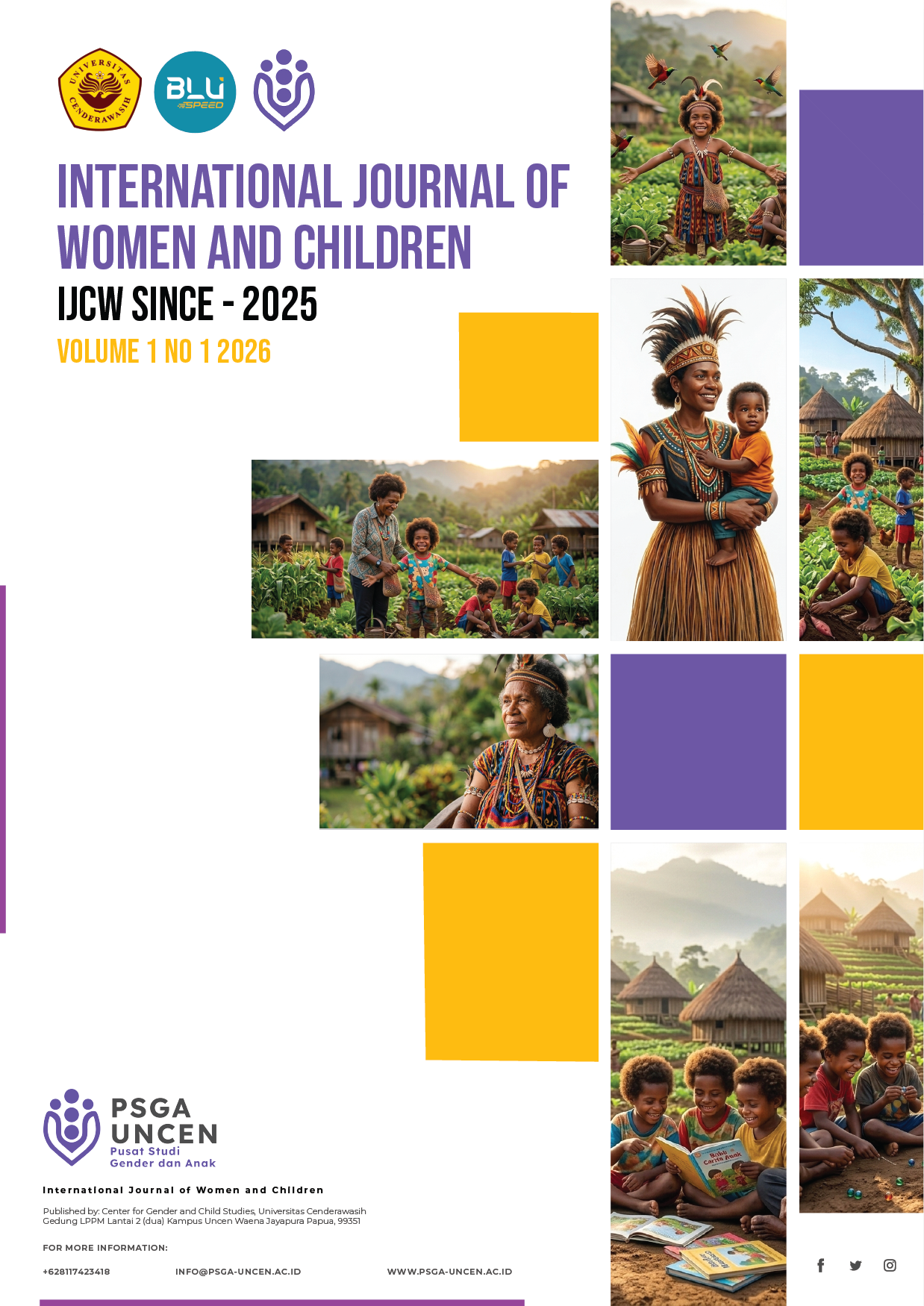
Negotiating Empowerment within Indigenous Structures: Socio-Cultural Pathways of Dani Women’s Economic Agency in Jayawijaya, Papua
DOI:
https://doi.org/10.66168/69wcqz52Keywords:
Indigenous women empowerment, Dani women, Socio-cultural entrepreneurship, Papua, Gendered development governanceAbstract
This study examines how empowerment among Dani indigenous women in Jayawijaya, Papua emerges through socio-cultural negotiation rather than purely economic intervention. While indigenous women play central roles in subsistence agriculture, cultural preservation, and household economies, structural barriers related to gender norms, education access, and institutional recognition continue to limit their agency. Using a qualitative interpretive design, the research integrates indigenous entrepreneurship theory, gender and development perspectives, and social capital frameworks to analyze empowerment pathways grounded in local cultural systems. Data were collected through in-depth interviews, observations, and document analysis involving indigenous women, community leaders, and local governance actors. Findings indicate that empowerment is shaped by five interconnected domains: education access, local-resource-based entrepreneurship, health resilience, leadership participation, and cultural preservation. Rather than replacing traditional roles, effective empowerment strategies emerge when economic initiatives align with indigenous values and collective identities. Conceptually, the study reframes indigenous women’s empowerment as a structurally embedded relational process rather than a linear development outcome. By positioning empowerment within cultural governance and community networks, the research contributes to debates on contextualized gender development and indigenous entrepreneurship in peripheral regions.
References
Agarwal, B. (2010). Gender and Green Governance. Oxford University Press. https://doi.org/10.1093/acprof:oso/9780199569687.001.0001
Az-Zahra, A. N., & Guntur, A. I. (2025). Indigenous knowledge and economic resistance: Local strategies against market penetration in Eastern Indonesia. Edelweiss Applied Science and Technology, 9(9), 206–214. https://doi.org/10.55214/2576-8484.v9i9.9785
Batliwala, S. (2007). Taking the power out of empowerment – an experiential account. Development in Practice, 17(4–5), 557–565. https://doi.org/10.1080/09614520701469559
Bhuwania, P., Mukherji, A., & Swaminathan, H. (2024). Women’s education through empowerment: Evidence from a community-based program. World Development Perspectives, 33, 100568. https://doi.org/10.1016/j.wdp.2024.100568
Brush, C. G., De Bruin, A., & Welter, F. (2009). A gender‐aware framework for women’s entrepreneurship. International Journal of Gender and Entrepreneurship, 1(1), 8–24. https://doi.org/10.1108/17566260910942318
Bullough, A., Guelich, U., Manolova, T. S., & Schjoedt, L. (2022). Women’s entrepreneurship and culture: Gender role expectations and identities, societal culture, and the entrepreneurial environment. Small Business Economics, 58(2), 985–996. https://doi.org/10.1007/s11187-020-00429-6
Cornwall, A., & Rivas, A.-M. (2015). From ‘gender equality and ‘women’s empowerment’ to global justice: Reclaiming a transformative agenda for gender and development. Third World Quarterly, 36(2), 396–415. https://doi.org/10.1080/01436597.2015.1013341
Dana, L. P. (2015). Indigenous entrepreneurship: An emerging field of research. International Journal of Business and Globalisation, 14(2), 158. https://doi.org/10.1504/IJBG.2015.067433
Elson, D. (2017). Recognize, Reduce, and Redistribute Unpaid Care Work: How to Close the Gender Gap. New Labor Forum, 26(2), 52–61.
Escobar, A. (2018). Designs for the pluriverse: Radical interdependence, autonomy, and the making of worlds. Durham: Duke University Press.
Halaç, D. S., & Çelik, T. S. (2019). A Qualitative Look into Gendered Entrepreneurship in Turkey. Istanbul Business Research, 47(2), 105–123. https://doi.org/10.26650/ibr.2018.47.2.0037
Henry, C., Foss, L., & Ahl, H. (2016). Gender and entrepreneurship research: A review of methodological approaches. International Small Business Journal: Researching Entrepreneurship, 34(3), 217–241. https://doi.org/10.1177/0266242614549779
Kabeer, N. (1999). Resources, Agency, Achievements: Reflections on the Measurement of Women’s Empowerment. Development and Change, 30(3), 435–464. https://doi.org/10.1111/1467-7660.00125
Lugones, M. (2010). Toward a Decolonial Feminism. Hypatia, 25(4), 742–759. https://doi.org/10.1111/j.1527-2001.2010.01137.x
McAdam, M., Harrison, R. T., & Leitch, C. M. (2019). Stories from the field: Women’s networking as gender capital in entrepreneurial ecosystems. Small Business Economics, 53(2), 459–474. https://doi.org/10.1007/s11187-018-9995-6
Peredo, A. M., & Anderson, R. B. (2006). Indigenous Entrepreneurship Research: Themes and Variations. In Developmental Entrepreneurship: Adversity, Risk, and Isolation (Vol. 5, pp. 253–273). Bingley: Emerald (MCB UP ). https://doi.org/10.1016/S1074-7877(06)05014-8
Peredo, A. M., & McLean, M. (2013). Indigenous Development and the Cultural Captivity of Entrepreneurship. Business & Society, 52(4), 592–620. https://doi.org/10.1177/0007650309356201
Ratten, V. (2023). Entrepreneurship: Definitions, opportunities, challenges, and future directions. Global Business and Organizational Excellence, 42(5), 79–90. https://doi.org/10.1002/joe.22217
Rauna Kuokkanen. (2011). Indigenous Economies, Theories of Subsistence, and Women: Exploring the Social Economy Model for Indigenous Governance. American Indian Quarterly, 35(2), 215. https://doi.org/10.5250/amerindiquar.35.2.0215
Razavi, S. (2017). The Political and Social Economy of Care in a Development Context: Conceptual Issues, Research Questions and Policy Options. United Nations Research Institute for Social Development, 50.
Smith, L. T. (2012). Decolonizing methodologies: Research and indigenous peoples (2nd ed.). London: Zed Books.
Tillmar, M., Ahl, H., Berglund, K., & Pettersson, K. (2022). The gendered effects of entrepreneurialism in contrasting contexts. Journal of Enterprising Communities: People and Places in the Global Economy, 16(5), 808–828. https://doi.org/10.1108/JEC-12-2020-0208
UN Women. (2024). WOMEN’S ECONOMIC EMPOWERMENT STRATEGY. UN Women.
United Nations Permanent Forum on Indigenous Issues. (2024). Indigenous women and development report. United Nations.
Unterhalter, E. (2005). Global inequality, capabilities, social justice: The millennium development goal for gender equality in education. International Journal of Educational Development, 25(2), 111–122. https://doi.org/10.1016/j.ijedudev.2004.11.015
Walter, M., & Andersen, C. (2013). Indigenous Statistics: A Quantitative Research Methodology. Walnut Creek, CA: Left Coast Press, Inc.
Welter, F., Baker, T., Audretsch, D. B., & Gartner, W. B. (2017). Everyday Entrepreneurship—A Call for Entrepreneurship Research to Embrace Entrepreneurial Diversity. Entrepreneurship Theory and Practice, 41(3), 311–321. https://doi.org/10.1111/etap.12258