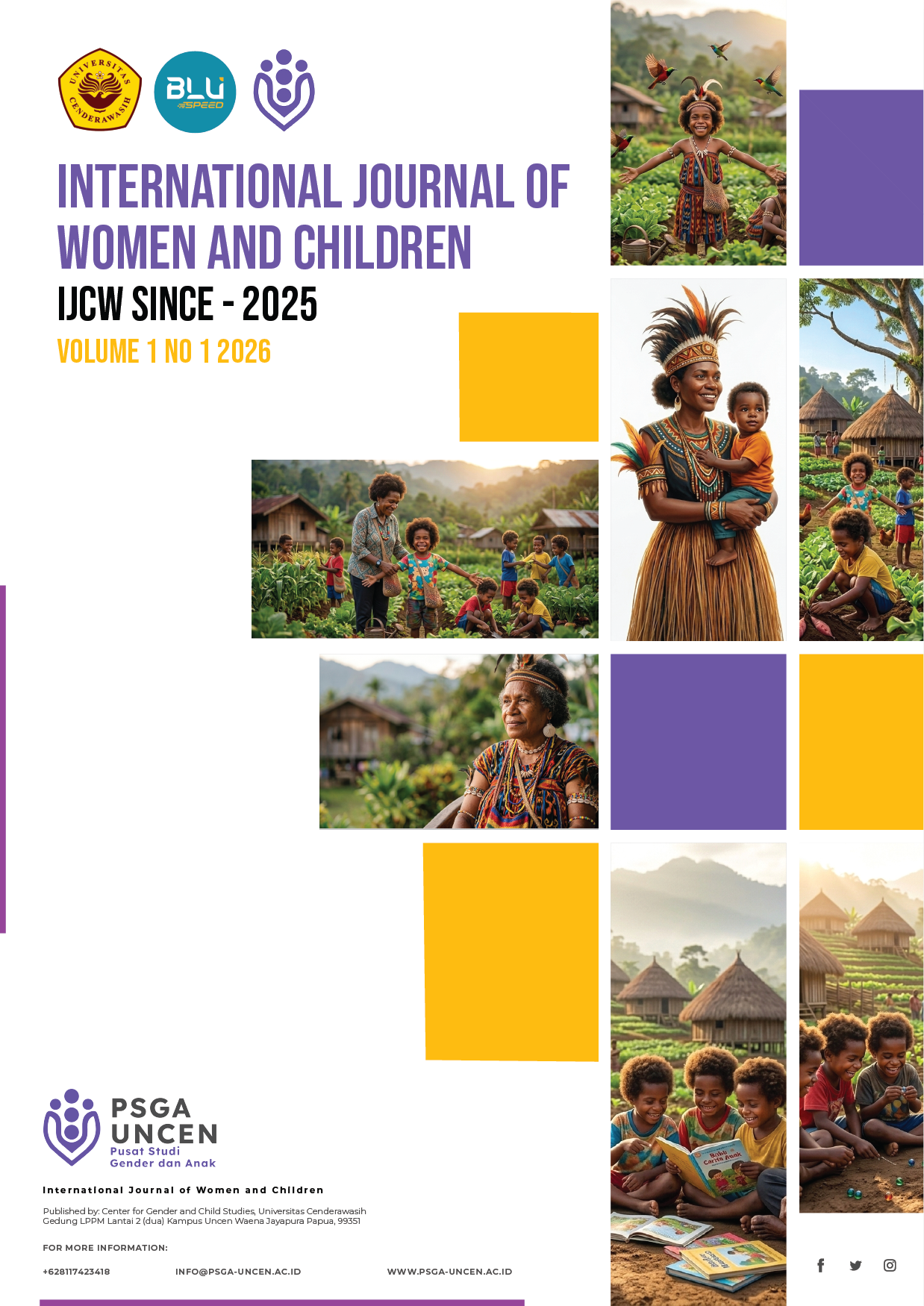
Indigenous Women Entrepreneurship as Cultural Capability: Local Wisdom, Gender Agency, and Economic Empowerment among Dani Women in Papua Highlands
DOI:
https://doi.org/10.66168/7j8y3h93Keywords:
Indigenous Women Entrepreneurship, Local Wisdom, Economic Empowerment, Gender and Development, Sustainable DevelopmentAbstract
Indigenous women’s entrepreneurship is increasingly recognized as a pathway toward inclusive and sustainable development; however, existing studies often treat local wisdom merely as cultural background rather than as a constitutive mechanism shaping entrepreneurial agency and economic empowerment. This study examines how Dani women’s entrepreneurship in Wamena, Papua Highlands, operates through indigenous knowledge systems and contributes to women’s economic empowerment within a socio-cultural context. Using a qualitative approach grounded in in-depth interviews, participant observation, and thematic analysis, the research explores how traditional values, collective practices, and gendered roles influence entrepreneurial activities. The findings reveal that local wisdom functions not only as a cultural identity marker but also as a strategic resource that strengthens resilience, social legitimacy, and economic participation among Dani women. Nevertheless, structural barriers—including limited access to capital, education, and markets—continue to constrain the scaling of indigenous entrepreneurship. The study contributes theoretically by repositioning indigenous entrepreneurship as an alternative development pathway rooted in relational agency and cultural continuity, extending current discussions on gender, entrepreneurship, and sustainable development. Practically, the findings suggest the need for culturally responsive empowerment policies that integrate indigenous governance structures, gender-sensitive economic programs, and locally grounded innovation strategies.
References
Abdelnaeim, S. M., & El-Bassiouny, N. (2021). The relationship between entrepreneurial cognitions and sustainability orientation: The case of an emerging market. Journal of Entrepreneurship in Emerging Economies, 13(5), 1033–1056. https://doi.org/10.1108/JEEE-03-2020-0069
Brush, C. G., De Bruin, A., & Welter, F. (2009). A gender‐aware framework for women’s entrepreneurship. International Journal of Gender and Entrepreneurship, 1(1), 8–24. https://doi.org/10.1108/17566260910942318
Bullough, A., Guelich, U., Manolova, T. S., & Schjoedt, L. (2022). Women’s entrepreneurship and culture: Gender role expectations and identities, societal culture, and the entrepreneurial environment. Small Business Economics, 58(2), 985–996. https://doi.org/10.1007/s11187-020-00429-6
Dana, L. P. (2015). Indigenous entrepreneurship: An emerging field of research. International Journal of Business and Globalisation, 14(2), 158. https://doi.org/10.1504/IJBG.2015.067433
Farida, N., Suman, A., & Sakti, R. K. (2021). Fiscal Decentralization, Economic Growth and Regional Development Inequality in Eastern Indonesia. Journal of Indonesian Applied Economics, 9(2), 1–9.
Henry, C., Foss, L., & Ahl, H. (2016). Gender and entrepreneurship research: A review of methodological approaches. International Small Business Journal: Researching Entrepreneurship, 34(3), 217–241. https://doi.org/10.1177/0266242614549779
Irjayanti, M., & Lord, L. (2024). Operating a business with local wisdom: A grounded research of women in the creative industry. Cogent Business & Management, 11(1), 2392047. https://doi.org/10.1080/23311975.2024.2392047
Lagrasta, F. P., Scozzi, B., & Pontrandolfo, P. (2024). Feminisms and entrepreneurship: A systematic literature review investigating a troubled connection. International Entrepreneurship and Management Journal, 20(4), 3081–3112. https://doi.org/10.1007/s11365-024-00977-3
McAdam, M., Harrison, R. T., & Leitch, C. M. (2019). Stories from the field: Women’s networking as gender capital in entrepreneurial ecosystems. Small Business Economics, 53(2), 459–474. https://doi.org/10.1007/s11187-018-9995-6
OECD & Global Women’s Entrepreneurship Policy network. (2025). Bridging the Finance Gap for Women Entrepreneurs: Insights from Academic and Policy Research. OECD Publishing. https://doi.org/10.1787/75b52972-en
Peredo, A. M., & McLean, M. (2013). Indigenous Development and the Cultural Captivity of Entrepreneurship. Business & Society, 52(4), 592–620. https://doi.org/10.1177/0007650309356201
Ratten, V. (2023). Entrepreneurship: Definitions, opportunities, challenges, and future directions. Global Business and Organizational Excellence, 42(5), 79–90. https://doi.org/10.1002/joe.22217
Roomi, M. A., Harrison, P., & Beaumont‐Kerridge, J. (2009). Women‐owned small and medium enterprises in England: Analysis of factors influencing the growth process. Journal of Small Business and Enterprise Development, 16(2), 270–288. https://doi.org/10.1108/14626000910956056
Tillmar, M., Ahl, H., Berglund, K., & Pettersson, K. (2022). The gendered effects of entrepreneurialism in contrasting contexts. Journal of Enterprising Communities: People and Places in the Global Economy, 16(5), 808–828. https://doi.org/10.1108/JEC-12-2020-0208
Welter, F., Baker, T., Audretsch, D. B., & Gartner, W. B. (2017). Everyday Entrepreneurship—A Call for Entrepreneurship Research to Embrace Entrepreneurial Diversity. Entrepreneurship Theory and Practice, 41(3), 311–321. https://doi.org/10.1111/etap.12258